To get your first 10 customers without ads, stop trying to reach everyone and go where a few buyers are already asking for help. Join the conversations on Reddit, X and LinkedIn groups where people ask for recommendations, post consistently on LinkedIn so those people can check you out, and reach out to your warm network with a specific offer. This guide gives you a 30-day plan you can run on 30 to 60 minutes a day.
In this guide: why the first 10 customers are different, five ways to find them, a 30-day plan, common mistakes, and an FAQ.
Why are the first 10 customers different?
The first 10 customers are not a marketing problem, they are a learning problem. You are not yet optimizing a funnel. You are finding out who has the problem badly enough to pay, what words they use, and what makes them say yes.
That is why ads are a poor first step. They cost money to teach you something a conversation would teach you for free, and without a clear message, they mostly teach you that your message is unclear. Direct, human channels work better at this stage because you can see the reaction and adjust the same day.
5 ways to get your first customers without ads
1. Join the conversations where buyers already ask
Every day, people write things like "Can anyone recommend a tool for this?" or "Alternatives to X?" in communities such as Reddit, X and LinkedIn groups. These are people in the middle of a decision.
How to do it:
- Write down 10 to 20 phrases your customers would actually type or post.
- Search them on each platform and sort by recent.
- Reply only to threads under 24 hours old, and answer the question first, with no link.
- Mention your product only if it truly fits, and say you work on it.
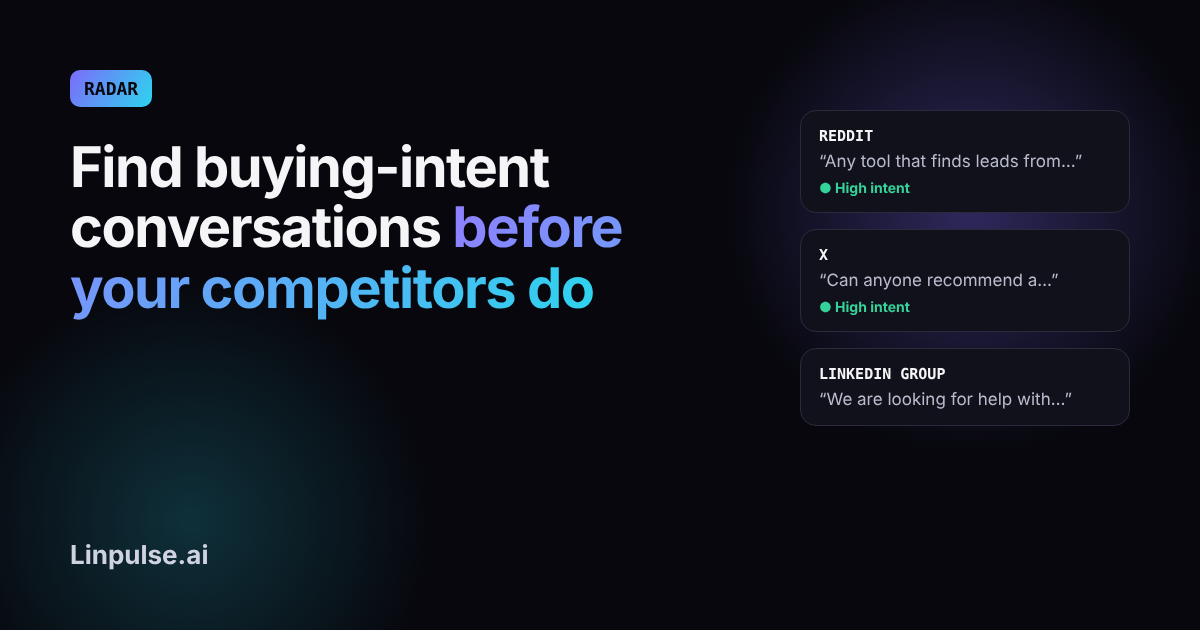
This is the highest-intent channel you have, and the one most founders skip because finding the threads takes time. Linpulse Radar automates the search: it watches Reddit, X and LinkedIn groups for conversations that match your product and drafts replies for you to approve.
2. Post on LinkedIn consistently
Someone who sees your helpful reply will often click your profile. What they find there decides whether they trust you. Three to five useful posts a week, each built around one lesson, one how-to or one honest story, turns your profile into a reason to say yes.
Batch the writing once a week, schedule the posts, and spend your daily time on comments. Linpulse Publish helps with drafting and scheduling for LinkedIn, and every post is reviewed by you before it goes live.
3. Message your warm network with a specific offer
Your first customers often come from people who already know you: former colleagues, clients, community members. Do not send a general "I built something" message. Write to 20 people individually, name the problem you solve for them, and make one specific, small offer.
Hi Dana, you mentioned your team spends hours on weekly reporting. I'm building a tool that cuts that down, and I'd like to set it up for you this week for free. Would a 15-minute call work?
4. Offer a free, specific piece of help
Choose one thing you can do in under an hour that shows your value: a quick audit, a template, a teardown, a setup. Offer it to 10 people in your target market and do it well. Customers are much more likely to buy from someone who has already solved a small problem for them.
5. Ask every early user for one introduction
When someone tries your product and likes it, ask a single question: "Who else do you know with the same problem?" One warm introduction is worth more than ten cold messages. Ask it right after a positive moment, and make it easy by offering to write the intro for them.
A 30-day plan
| Week | Focus | Daily time | Goal |
|---|---|---|---|
| 1 | Define the customer, write 15 search phrases, update your LinkedIn profile | 45 min | A clear message in one sentence |
| 2 | Reply in 3 to 5 threads a day, send 10 warm messages | 45 to 60 min | 5 real conversations |
| 3 | Post 3 to 5 times on LinkedIn, offer your free help to 10 people | 45 min | 3 trials or demos |
| 4 | Follow up, ask for introductions, write down what worked | 30 min | First paying customers |
Treat the numbers as targets to adjust, not promises. Your market, price and product decide how fast it goes.
6 mistakes to avoid
- Selling in the first sentence of every reply.
- Writing to everyone instead of one kind of customer.
- Skipping the follow-up. Many yeses come on the second message.
- Posting for a week, then stopping.
- Giving a discount before understanding the real objection.
- Not writing down what people say. Their exact words become your best marketing copy.
Frequently asked questions
How long does it take to get your first 10 customers?
It depends on your product, price and market. For many small B2B products it takes weeks to a few months of steady effort. Track conversations and replies weekly, because they are the leading signal before revenue.
Should I offer a free trial or a discount?
A free trial lowers the barrier to starting, and it works best when the first result is quick to see. A discount is best saved until you understand why someone hesitates, since price is often not the real reason.
Do I need a big LinkedIn following to get customers there?
No. Early customers usually come from a small number of well-chosen conversations and a profile that clearly says whom you help. Quality of attention matters more than follower count.
Can I automate all of this?
You can automate the repetitive parts, such as finding conversations, drafting replies and scheduling posts. Keep the human parts yourself: your judgment, your examples and the final approval of everything you publish.
Start today
Pick one kind of customer, write 15 phrases they would use, and reply to your first three conversations today. When you want help finding the right conversations and keeping your LinkedIn active, try Linpulse free.