Most professionals know they should post on LinkedIn regularly. Very few actually do. The reason is rarely a lack of ideas. It is the daily friction: opening a blank box, deciding what to say, polishing it, and doing it all again tomorrow. After two or three weeks, life gets busy, the habit breaks, and the profile goes quiet.
This guide shows a simple weekly system that keeps you visible on LinkedIn and X without turning content into a second job.
Why consistency beats brilliance
LinkedIn rewards people who show up. A steady rhythm of useful posts builds familiarity: people start to recognize your name, remember what you work on, and think of you when a relevant need comes up. One brilliant post followed by three silent months does far less than a modest post every few days.
Consistency also gives you data. When you publish regularly, you can see which topics get replies, which formats get ignored, and what your audience actually cares about. Without a rhythm there is nothing to learn from.
The real reason people stop posting
People rarely quit because writing is hard. They quit because the process has too many decisions every single day:
- What should I post about today?
- Is this good enough?
- When should I publish it?
- Did I already cover this topic last week?
Each decision is small, but together they drain energy. The fix is not more motivation. It is moving those decisions out of the daily routine.
A simple weekly system
The goal is to make one planning session cover the entire week. Here is a structure that works for most professionals.
1. Choose your topics once
Pick three to five themes you can talk about with real authority: your industry, lessons from your work, tools you use, mistakes you have seen, questions your customers keep asking. Write them down. You will come back to these themes again and again, and that is exactly the point. Readers do not get tired of a clear focus. They get confused by a scattered one.
2. Choose your posting days
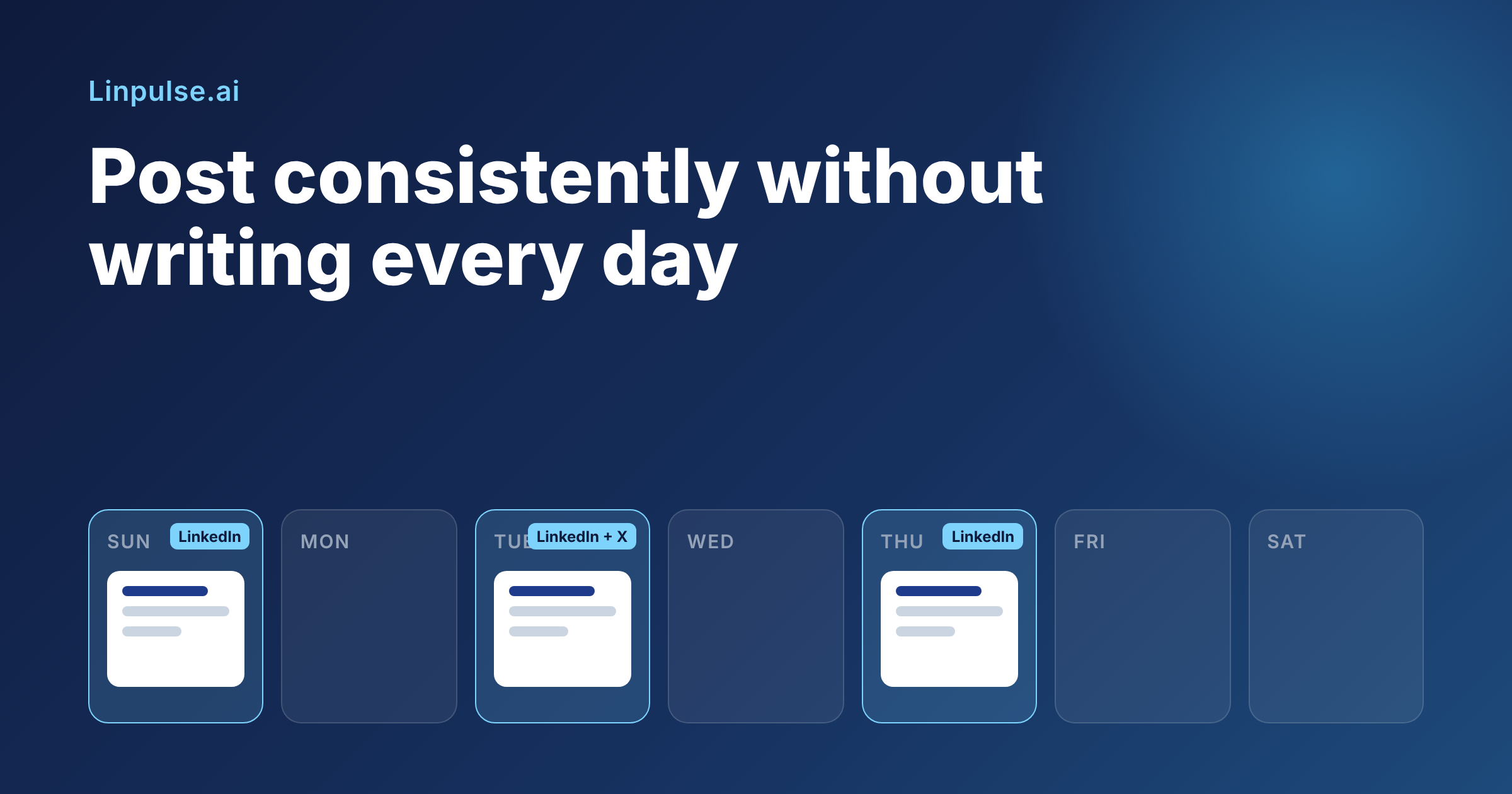
You do not need to post every day. Three to five days a week is enough for most people, and a schedule you can keep beats an ambitious one you abandon. Decide which days and roughly what time, then stick to it.
3. Plan the whole week in one sitting
Instead of deciding each morning, spend a short session once a week choosing what goes out and when. Planning is faster than writing, and when the week is already laid out, a busy Tuesday cannot break your streak.
4. Review before anything goes live
Never publish blind. Read each post, fix anything that does not sound like you, and remove anything you are not comfortable standing behind. A two minute review keeps the quality high and the voice yours.
5. Publish on a schedule
The final step is taking yourself out of the moment. When posts go out at planned times, you stop depending on remembering to do it. Consistency becomes the default instead of an act of willpower.
What to post when you run dry
Evergreen posts are your safety net. These are posts that stay useful no matter when they are read: a framework you use, a common mistake and how to avoid it, a short lesson from a recent project, a checklist, an honest answer to a question you hear often. Keep a running list of these so a quiet week never leaves you empty handed.
A good mix is mostly evergreen posts with the occasional timely thought when something genuinely relevant happens in your field.
Common mistakes to avoid
- Posting in bursts. Ten posts in one day followed by silence teaches your audience nothing. Spread them out.
- Chasing every trend. A focused voice beats a reactive one.
- Skipping review. Automation without a human check is how awkward posts happen.
- Aiming for perfect. A good post that goes out beats a perfect post that never does.
- Ignoring X. Many ideas work on both LinkedIn and X when you adapt the length. Writing once and adapting saves time.
How Linpulse.ai Auto Feed fits in
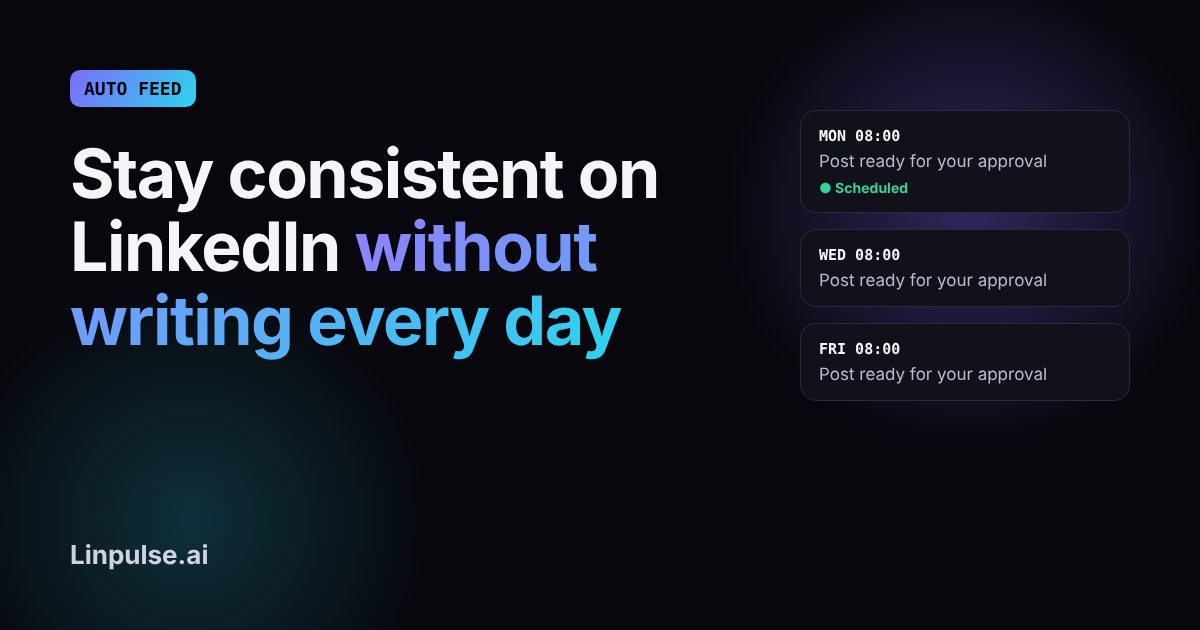
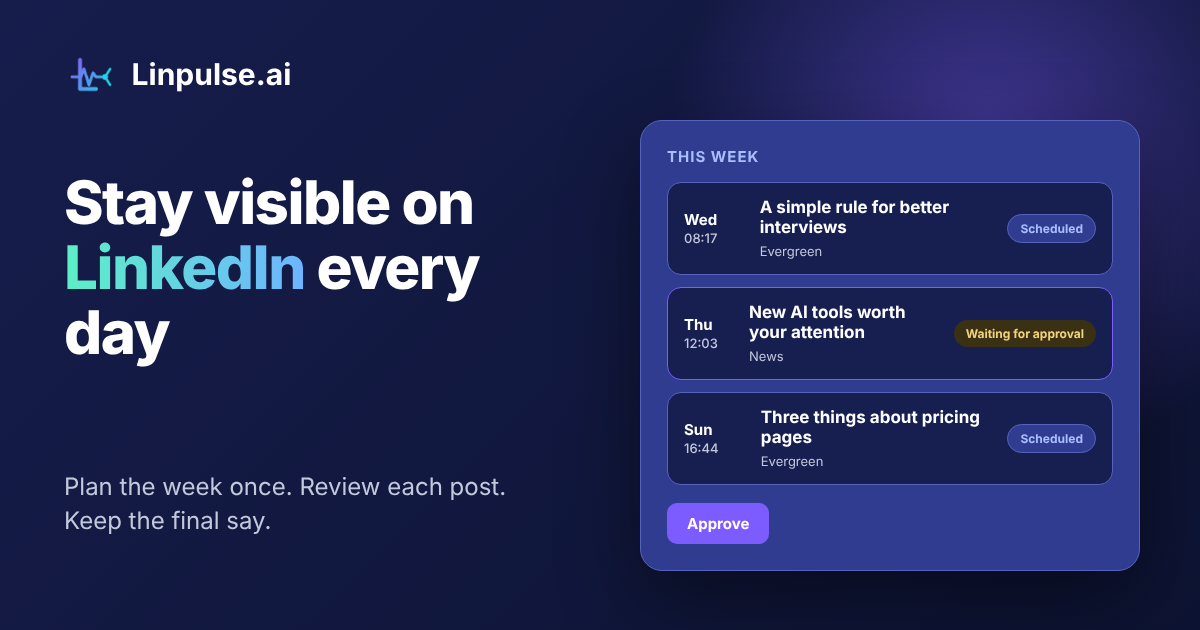
Auto Feed is built around exactly this weekly system. You choose your topics, the days you want to post, how many posts per day, and your language. Linpulse.ai then plans your week of posts for LinkedIn and X, and you review them before anything is published. You can edit a post, replace one you do not like, or cancel it.
Once you trust the results, you can switch on automatic publishing so approved weeks run on their own. Posts go out at the planned times from your own accounts through the Linpulse.ai Chrome extension, so keep Chrome open on your computer when a post is scheduled.
Auto Feed starts with a 14 day free trial and does not ask for a card, so you can see a full week of planned posts in your own voice before deciding anything.
Getting started this week
- Write down three to five themes you want to be known for.
- Pick three posting days and a rough time.
- Plan this week's posts in one sitting.
- Review them, then schedule them.
- Look at what got replies and adjust next week.
The habit you are building is not writing every day. It is showing up every week, on purpose, with very little daily effort. That is what keeps a profile active long enough for the results to arrive.
Ready to try it? Start your free Auto Feed trial at Linpulse.ai and have a full week of posts planned in minutes.